A Sondheim Spring... Isn't it rich?
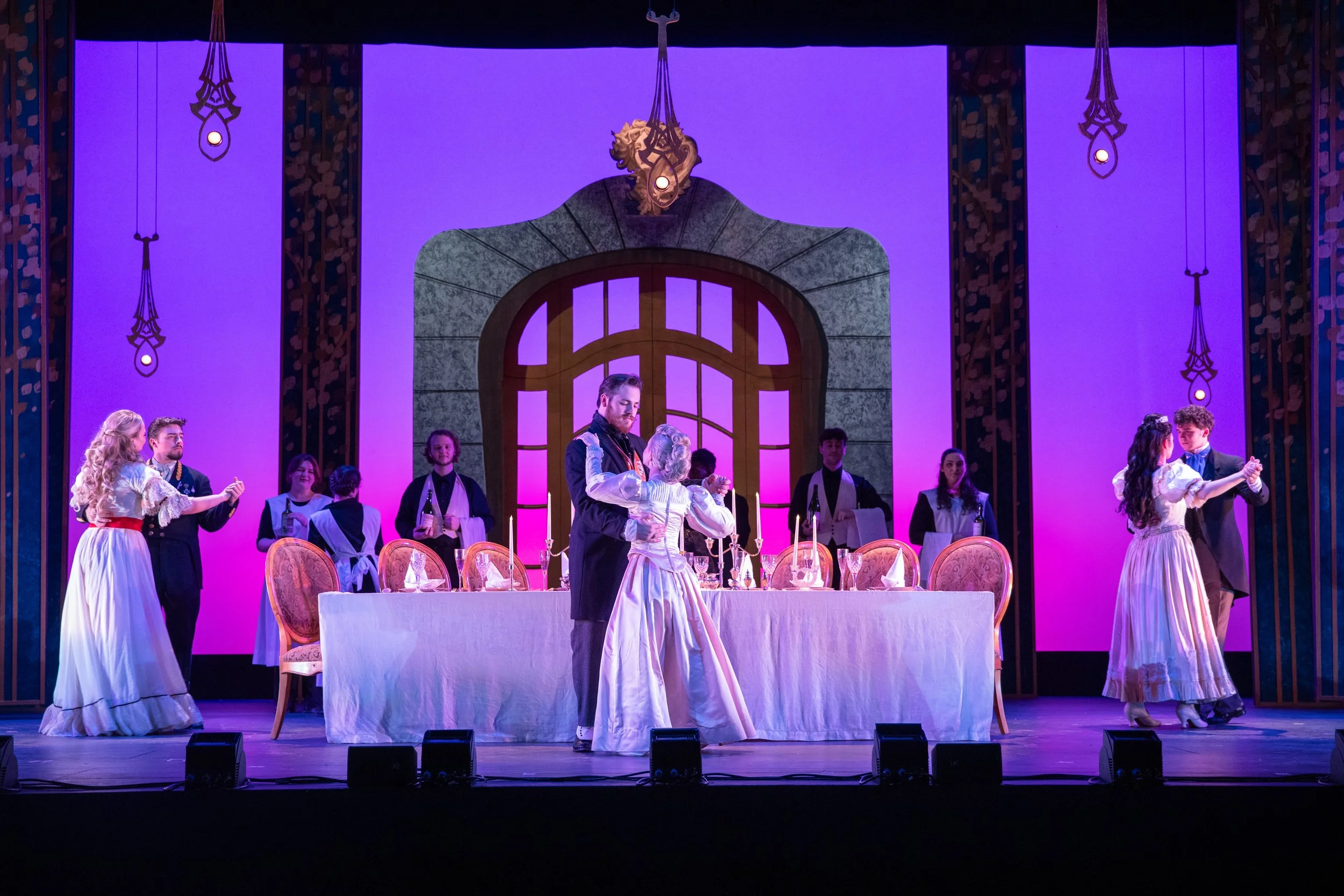
The Dinner Waltz. Photo by Dalia Shaw.
I’ve had the pleasure to direct several productions at my alma mater since returning to teach. The first felt like a match made in heaven: directing The Merry Wives of Windsor for the 75th annual Hofstra University Shakespeare Festival, on Hofstra’s Globe Stage, a state-of-the-art recreation of Shakespeare’s home theatre, the most accurate such recreation in the United States. The second was a curveball that really took me out of my comfort zone: the 1930’s screwball comedy You Can’t Take It with You, a project I joined at the last minute with no prior experience of the play, and very little of the genre. This spring, I had an opportunity to split the difference and work on a piece very dear to my heart, but very far outside of my directorial lane: Stephen Sondheim’s romantic masterpiece A Little Night Music.
Like many theatre artists, I grew up doing youth community theatre. For the major youth theatre in my little corner of Massachusetts, musicals were the name of the game, and as a young actor who was not much of a singer, I treasured the opportunities to be onstage but always felt a little like an outsider… with one major exception. My very first theatre mentor, Christa Crewdson, who was a frequent director at this theatre, was a Sondheim fanatic, and she programmed his work as frequently as she could. (This is how, before I turned 16, I had done Into the Woods — not the junior version that’s just Act 1, the whole show — twice.) Something about Sondheim activated my imagination in a way the other musicals did not. They weren’t just fun and entertaining, they were brilliant. I felt so much going right over my teenage head, and rather than being alienated or discouraged, I desperately wanted to understand more. Eventually this theatre company established a summer program where returning college students could audition, along with high school upperclassmen, to take on more mature fare, and this is where I got my first taste of Sondheim’s weirder, darker oeuvre: Assassins, Sweeny Todd, etc. I later found that same thrill in the works of Shakespeare, Beckett, and other great writers during my time at Hofstra and Columbia, but that first spark of interest in challenging theatre is very much thanks to Sondheim.
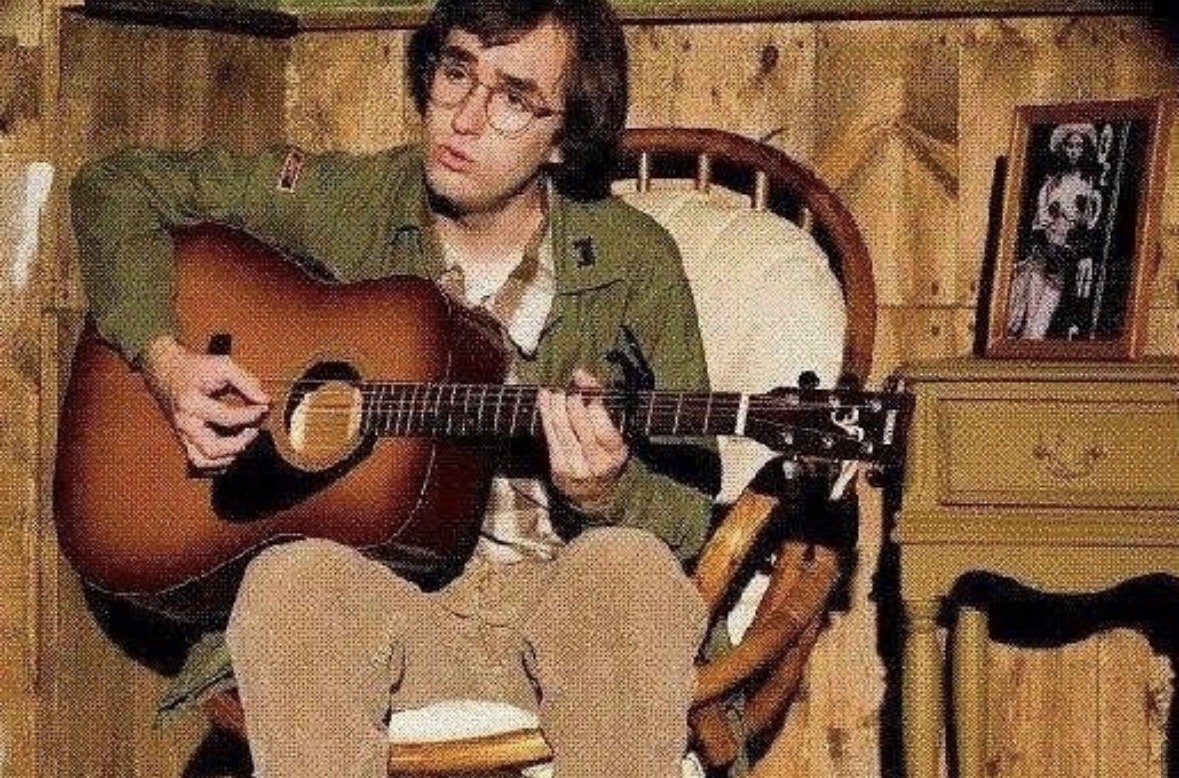
From the archives: teenage me playing John Hinckley in Assassins (and proof that I did once have that much hair)
When I found out that the spring musical at Hofstra would be A Little Night Music, I immediately let the powers that be know that it was a particular favorite of mine — quite possibly my favorite musical. When I was offered the job, the uncertainty crept in. I hadn’t directed a full musical in fifteen years… in fact, the last time I did, I was a student at the very same university. I certainly had never directed a musical with a 19-piece orchestra. Was I in over my head? Luckily for me, I had a team that was willing and able to help me adjust to a new workflow. Music director Kerry Prep and choreographer/costume designer Meredith van Scoy, two of my colleagues at Hofstra, had worked together on several musicals there, and were able to answer my (frequent) questions.
The research portion of the process was particularly rewarding for me. I returned to the play’s source material, the Ingmar Bergman film Smiles of a Summer Night, which I had not seen for many years. The film (and the play) are the story of the middle-aged lawyer Fredrik Egerman and his former lover, the great actress Desirée Armfeldt. After the death of his first wife, and after the affair with Desirée that followed, Fredrik has married a beatuiful young girl, Anne, who is about the same age as his son. Desirée and Fredrik reconnect, and, sensing that he is as unhappy in his marriage as she is tired of life on the road, hatches a plan to bring them together. We see the various love triangles slowly sort themselves out over the course of a weekend at the Armfeldt country estate. Sondheim takes the wistful midsummer magic of Bergman’s film and fills it with a rich, complex, musical and emotional life without losing the humor of the source material.
I also returned to Sondheim’s invaluable book Finishing the Hat, the first volume of an annotated collection of his lyrics, which included many great behind-the-scenes stories of the play’s development, as well as some very informative lyrics for songs that were cut at various points. Research also meant spending several summer afternoons in the New York Public Library for the Performing Arts at Lincoln Center, watching various productions of the play to see how other directors had tackled some of the show’s more abstract challenges. I even got to do a little field research: I learned that the Bergman film had been shot at a small country estate in Skåne, the southernmost part of Sweden. My wife is from Denmark, and while spending some time with her family over the summer, I realized the location, Jordberga Castle, was just a 40 minute drive from Malmö, just across the water from Copenhagen. As luck would have it, I was already scheduled to have a meeting at a university in Malmö in late June, so we took the train over the Øresund, rented a car, and drove out to Jordberga, where the midsummer weather was exactly as described in the film. I took tons of photos of the grounds, which I sent to our design team to help them get a feel for the specific location and time of year.
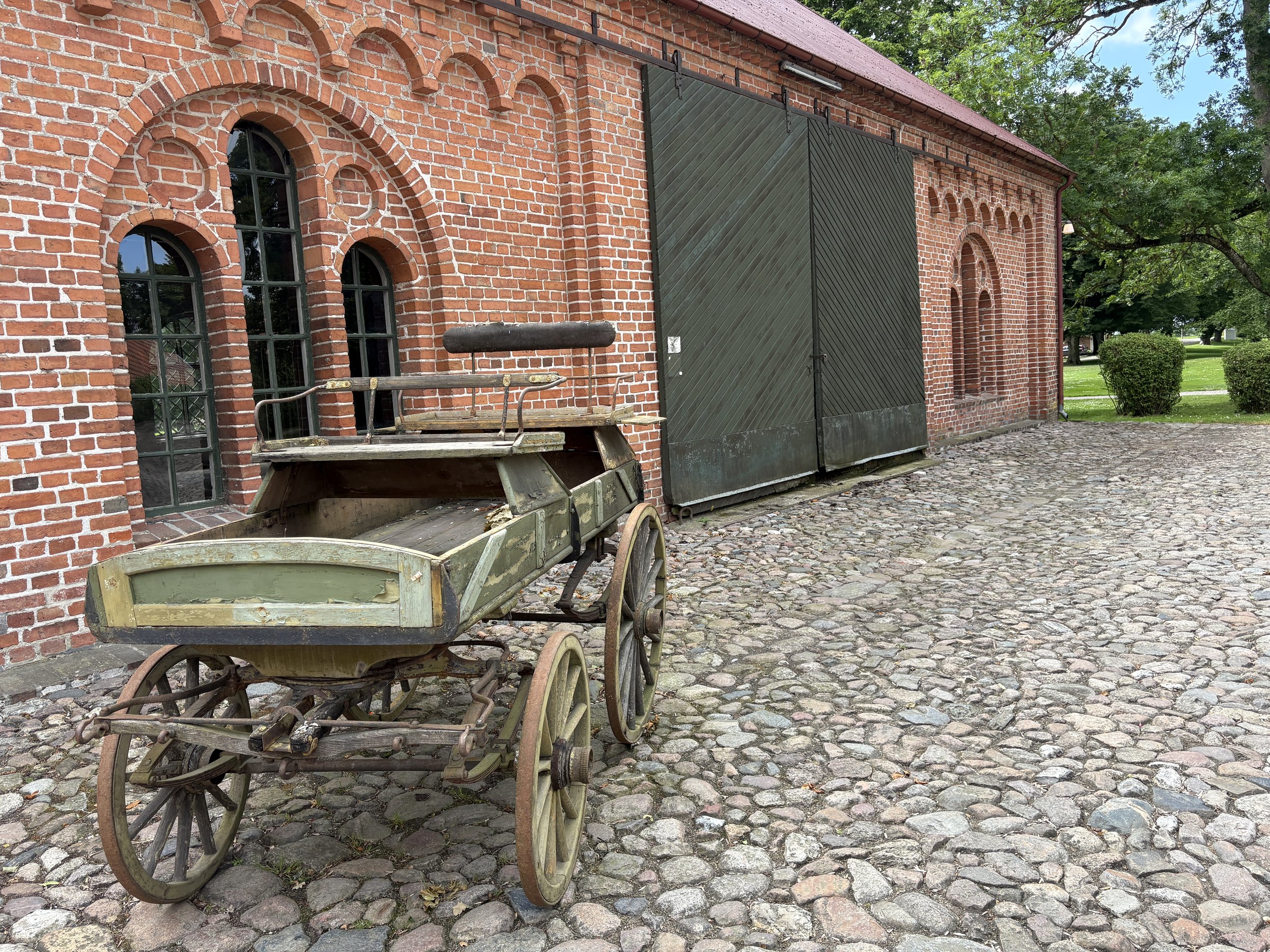
The garage at Jordberga Slott, now one of many event spaces on the grounds, which have been converted into a beautiful hotel.
I discovered in reading Sondheim’s notes that two original ideas about the play had been discarded in the process of writing the book, as librettist Hugh Wheeler found them too abstract and challenging to incorporate. The first was that Madame Armfeldt, the matriarchal mother of Desirée, would be an almost Fate-like figure, whose games of solitaire would take on a Tarot-like quality, reshuffling the narrative into three different takes on the story. The second was that Fredrika, Desirée’s daughter, was to be the perspective character, and the audience would watch the foibles of the grown-ups to some extent through her eyes. While I strongly believe in doing the play that’s in front of you, and not the play you wish it were, I was curious: would we be able to draw some of these buried strands out of the fabric of Night Music, making it a little more fantastical, while still maintaining its structure?
All of this research paid off in the design process. Our lighting designer, Brian Canese, did an incredible job of creating both the warm interior light of the period and the almost psychedelic colors of the eternal sunset that drives the second act. Meredith’s costumes were color-coded: characters would appear with pops of color in scenes with Fredrika present but in greyscale versions of the same costumes in scenes where she’s absent, emphasizing her perspective. And David Henderson took visual cues from my photos and his own historical research and designed an extraordinary set made up of independently moving art deco-inspired panels, four large ones which divided the living spaces in the entirely-indoor first act and several more slender ones to indicate trees in the mostly-outdoor second act. The result was both elegant and impressive, creating a beautiful contrast between the cavernousness of the space and the intimate settings of the scenes..
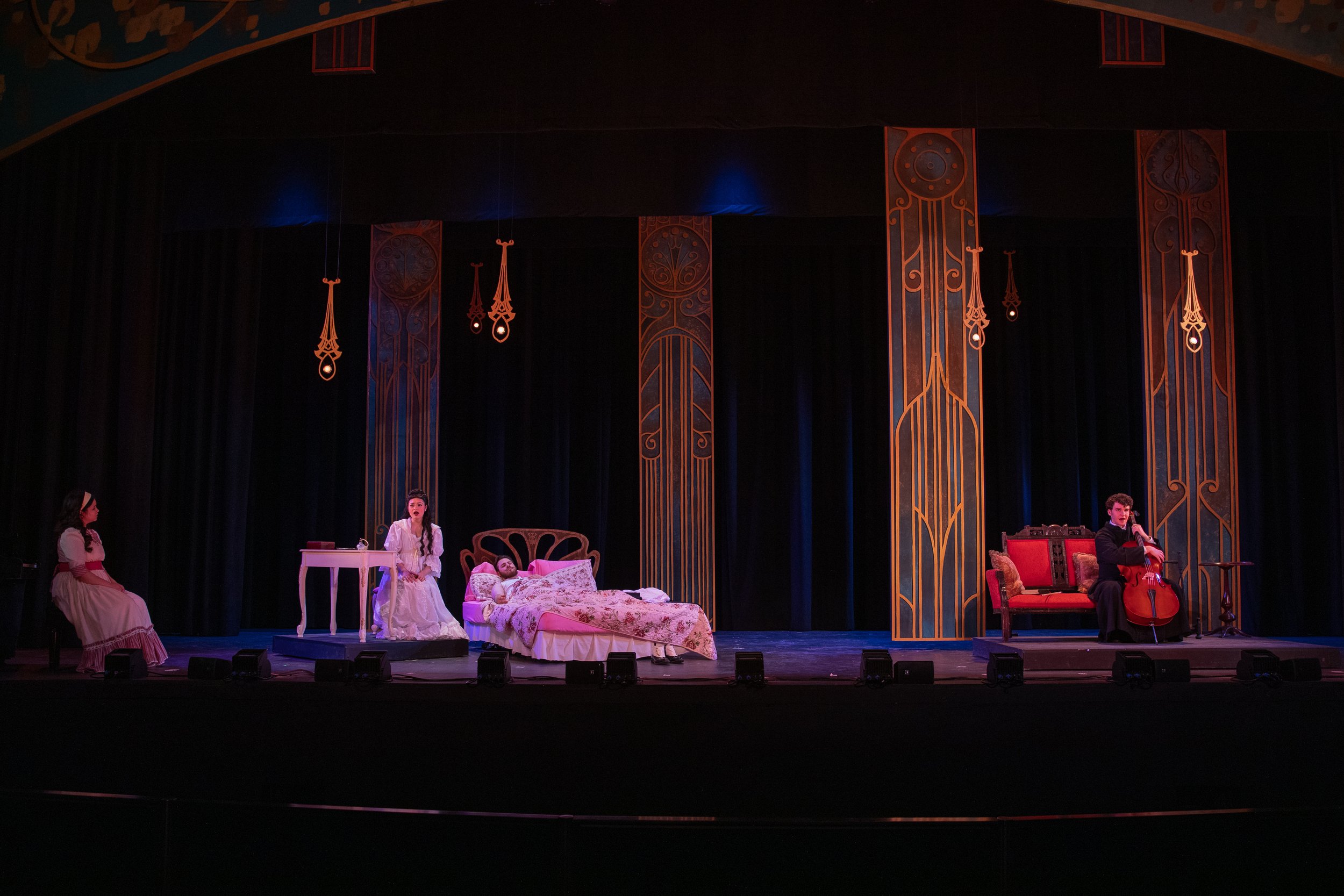
The Egerman rooms, with Fredrika “watching.” (L-R: Lilly Lazo, Bree Kuliga, Andrew Heitmann, Andrew Canese.) Photo by Mia Thompson.
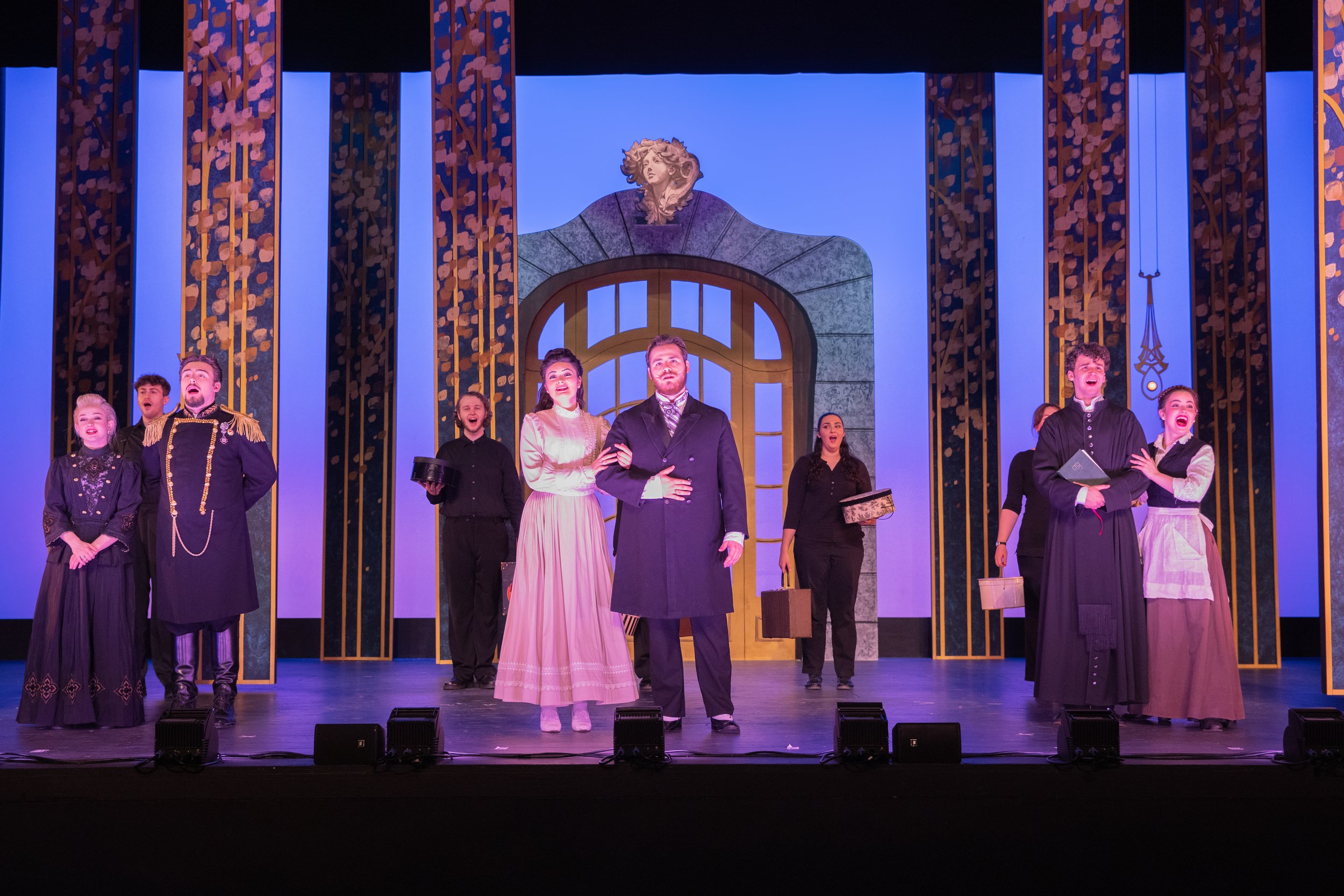
“A Weekend in the Country.” (L-R: Jordan Reilly, Adam Schwartz, Sam Chetikin, Tristan Rogers, Bree Kuliga, Andrew Heitmann, Gabriella Vallerugo, Audrey Pratt, Andrew Canese, Mallory Alvarez.) Photo by Dalia Shaw.
Casting, we know, would be a challenge: A Little Night Music is largely a play about aging and lost love, and how people respond to the regrets of middle-age differently, and by virtue of it being a university production, our actors were all between the ages of 18-22. The music is also incredibly complex, even for Sondheim: famously, the entire score (save for a few measures of underscoring) is written in some version of 3/4 time, with may passages of overlapping and counterpoint that can be head-spinning at first glance. One of the most puzzling parts of the play is “the Quintet,” sometimes called the Liebeslieders, who take the place of a traditional musical ensemble and function more like a Greek chorus. Are they servants? Are they anonymous neighbors? Are they ghosts? Different productions have handled them differently, and there’s no clear answer in the text. While researching, I was struck by an exciting possibility: what if they are just the crew of the play the audience is watching? The characters as written sometimes “take on” roles in the play, like Desirée’s co-stars, so why not take this to its logical conclusion, and have them break the fourth wall and run the show? This would mean, though, that not only would our Quintet need to be able to sing their incredibly dense music, but to be moving scenery, quick-changing, and hat-switching pretty much nonstop. It’s a lot to ask of any actor.
After auditions and callbacks, Kerry, Meredith and I felt completely at ease. Not only had we found students who could engage believably with the more mature aspects of the piece, but we found actors with great comedic timing and voices to match who could fill out the rest of the ensemble, and a Quintet of brilliant physical performers who were willing to think on their feet and devise some of their sequences with me. (We even found a Henrik who could not only hit his infamous high note, but could actually play the cello!) We watched Smiles of a Summer Night together before we broke for the holidays to help kick-start their imaginations, and I went home to figure out how to approach staging this behemoth.
The rehearsal process was challenging. There was not enough time (is there ever?) and we lost three full rehearsals to snow. Our tech process was short, and the reality of our beautifully intricate set in when we realized that the theatre’s old-school fly system meant all the panel movements would have to be manually operated by backstage crew members pulling on ropes. This would be quite a challenge for professional theatre technicians, and we had a student crew, many of whom had never worked with rigging before. But despite a bumpy start, they rose to the occasion, and things slowly began to come together. By opening night, the incredible collaboration of our designers, actors, musicians, and technicians came into beautiful focus. I could not have been happier with the result.
Per Hofstra tradition, I had to make a brief speech in the green room before closing night that would end with a line I had selected from the show. Listening to these speeches over the course of the run, I was struck with a familiar, paralyzing anxiety about what to say. How could I sum up what this whole process had meant to me? One day, I was struck by a fond memory of my high school days working on Sondheim with Christa my youth theatre friends. Sondheim, as many theatre folks know, was famous for his letter-writing. If you wrote him a letter about his work, no matter who you were, there was a very high chance he would eventually respond. (After his passing, many theatre luminaries shared the letters they wrote to him early in their careers, as well as his touching replies.) This was as true for Broadway actors as it was for youth community theatres in suburban Massachusetts: every time we worked on one of his shows, Christa would write to him about it, and he would respond with gratitude and words of encouragement. It meant a lot to us to know that he was aware of our little shows. I had always hoped to someday write one of those letters myself, but I never got the chance. I decided, in lieu of a speech, to write that letter anyway, and read it to the cast and crew. I will keep that letter private — it’s between me, the team, and Steve, wherever he is — but I will say that the line I chose from the play is the climactic lyric of “The Miller’s Son,” the maid Petra’s ode to living life to the fullest that, to me, is the thesis statement of the play. “There’s a lot I’ll have missed,” she says, “but I’ll not have been dead when I die.”
A Little Night Music is about death: the death of dreams, the death of love, the death of those who raise us and teach us. But like all great art about death, it is actually about life, and how endings make us better appreciate both the things we still have and also the things that may someday come. I am so grateful for this opportunity to challenge both myself and my students to live just a little bolder, to love a little deeper, to be a little truer to ourselves, and to trust that whatever we miss, it’ll be worth it if we pursue what we love.
Make way for the clowns.
Applause for the clowns.
They’re finally here.
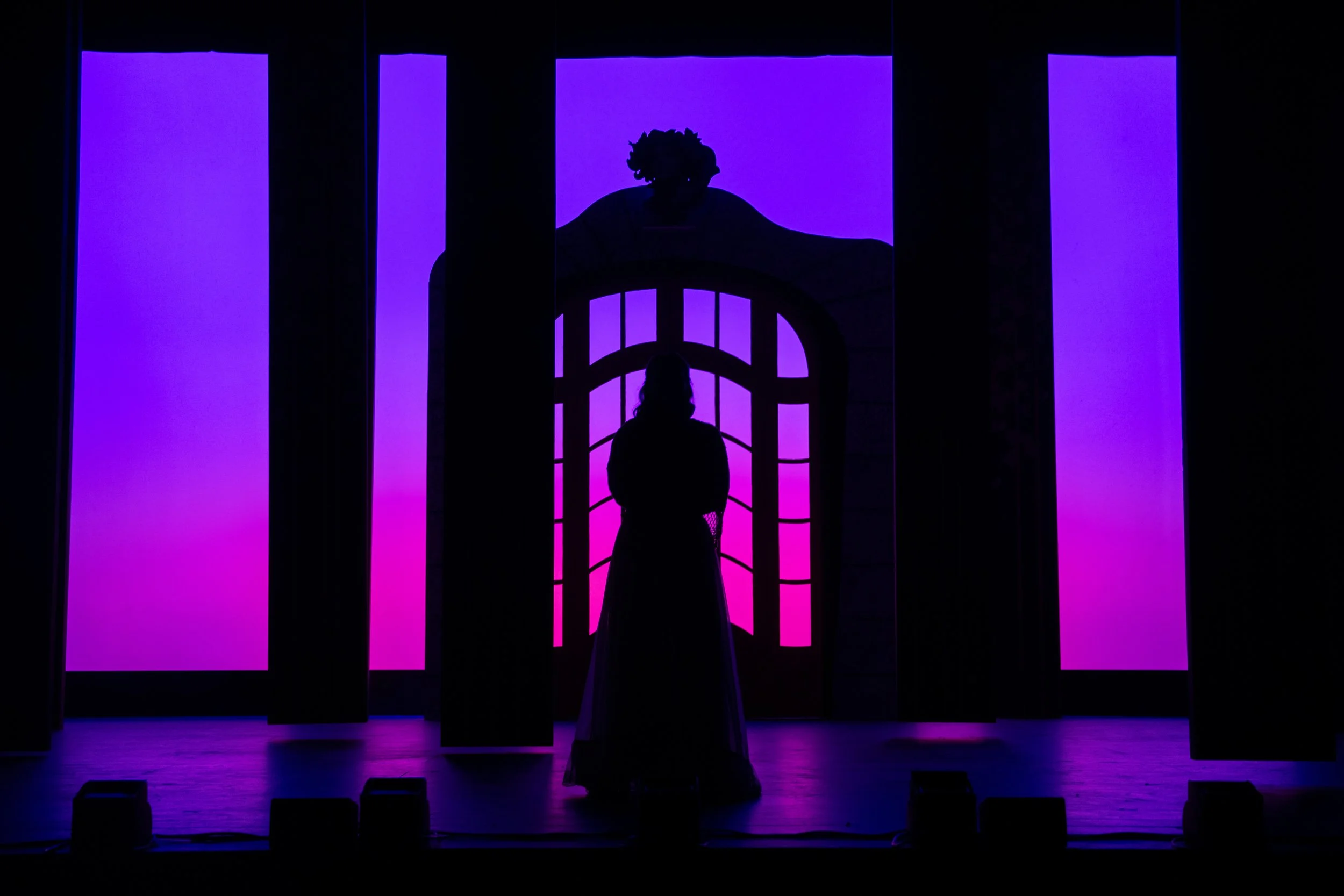
“Well, maybe next year...” (Bela Valente.) Photo by Dalia Shaw.